Free Online Tool · No signup required

SIP Calculator
Calculate Your Returns Instantly

Calculate your Systematic Investment Plan returns in seconds. See how compounding turns monthly investments into long-term wealth.

Last updated: June 2026 · Reviewed for accuracy

SIP Return Calculator
Investment Parameters
Monthly Investment ₹ 10,000
Expected Annual Return 12%
Investment Period 10 Yrs
Total Invested ₹ 12,00,000
Est. Returns ₹ 10,99,496
Wealth Multiplier 1.92x
Future Value ₹ 23L
Invested Amount ₹ 12,00,000
Estimated Returns ₹ 10,99,496
+91.6% total gain over 10 years
Disclaimer: Results are estimates based on a fixed assumed return rate. Actual mutual fund returns vary with market conditions. This tool is for informational purposes only — not financial advice.
₹1000

Minimum SIP / Month

10–14%

Avg. Equity Returns p.a.

40 Yrs

Max Investment Period

3 Mins

To Set Up a SIP

Understand the Basics

What is a SIP Calculator?

SIP Calculator is a free online financial tool that instantly estimates the future value of your Systematic Investment Plan (SIP) investments. Instead of manually working through compound interest formulas, you simply enter three inputs — your monthly investment amount, the expected annual return rate, and the investment duration — and the calculator does the rest in real time.

Our SIP return calculator goes beyond a basic number — it shows you the exact split between the money you put in and the returns generated through compounding, visualised through an interactive chart. This helps you understand the true power of long-term disciplined investing.

What is SIP?

A Systematic Investment Plan (SIP) is a method of investing a fixed amount at regular intervals — typically monthly — into a mutual fund or other financial instrument. SIP is not itself an investment product; it is a technique for investing in Mutual Funds, Index Funds, Gold, and more.

Unlike lump sum investing, SIP allows anyone to start building wealth with as little as ₹500 per month, without needing to time the market or have a large initial capital.

How Does SIP Work?

When you start a SIP, a fixed amount is automatically debited from your bank account on a set date every month. This amount is used to purchase units of your chosen mutual fund at the current NAV (Net Asset Value). Over time, you accumulate units — more when prices are low, fewer when they are high.


This automatic purchase mechanism means you are always invested, removing emotional decision-making from the equation. Over years, compounding turns these regular contributions into significant wealth.

The Math Behind It

SIP Return Calculator Formula Explained

Our SIP calculator uses the standard future value of annuity formula — the same formula used by SEBI-registered investment platforms and financial advisors globally. Understanding it helps you trust the output and plan with confidence.

The SIP Formula

FV = P × [ ((1 + i)ⁿ – 1) / i ] × (1 + i)

📐 Worked Example

Suppose you invest ₹10,000/month for 10 years at an expected annual return of 12%.

Monthly rate i = 12 ÷ 12 ÷ 100 = 0.01  ·  n = 10 × 12 = 120 months

FV = 10,000 × [((1.01)¹²⁰ – 1) / 0.01] × 1.01 = approx. ₹23.23 Lakhs

Total invested = ₹12 Lakhs  ·  Returns generated = ₹11.23 Lakhs — almost equal to your investment, purely from compounding.

Step by Step

How to Use This SIP Calculator

Our calculator is designed for instant results with zero learning curve. Here is how to get the most out of it in under 60 seconds.

01

Select Your Currency

Choose INR (₹), USD ($), or GBP (£) from the currency selector at the top right of the calculator. All values and results will automatically reformat to your chosen currency.

02

Set Your Monthly Investment

Drag the slider or click the value badge to type a custom amount. This is the fixed amount you plan to invest every month. Start with what you can comfortably commit — even ₹1,000/month makes a significant difference over 15–20 years.

03

Enter Expected Annual Return

This is your assumed rate of return per year. Use 10–12% for equity mutual funds (conservative), 6–8% for debt funds, or 13–15% for aggressive/small-cap focused portfolios. The calculator adjusts results in real time as you slide.

04

Choose Your Investment Period

Set the number of years you plan to stay invested. The longer the period, the more dramatic the compounding effect. Try comparing 10 vs 20 years with the same monthly amount — the difference will surprise you.

05

Read Your Results Instantly

The calculator instantly shows your Total Invested amount, Estimated Returns, Future Value, and Wealth Multiplier. The donut chart and progress bars visually break down what compounding contributed vs. what you put in directly.

Why SIP Works

Key Benefits of SIP Investment

SIP is not just a convenient way to invest — it is a psychologically and mathematically superior approach to long-term wealth creation for most individual investors. Here is why.

Rupee cost averaging graph showing SIP Calculator unit buying at low and high NAV prices

Rupee Cost Averaging

When markets fall, your fixed SIP amount buys more mutual fund units. When markets rise, you buy fewer. Over time, this averages out your cost per unit — protecting you from investing a large amount at a market peak.

Compound interest growth chart showing SIP investment doubling over 20 years

Power of Compounding

Returns earned on your investment begin earning their own returns. This compounding effect accelerates dramatically over time — a ₹10,000/month SIP over 20 years at 12% grows to over ₹99 lakhs, with only ₹24 lakhs invested directly.

Auto-debit calendar icon representing disciplined monthly SIP investing habit

Disciplined Investing

SIPs run on auto-debit from your bank. This removes the temptation to skip investing during market downturns — which is exactly when you should be buying more. Consistency is the single biggest driver of SIP success.

Liquidity comparison showing SIP withdrawal versus fixed deposit lock-in period

High Liquidity

Unlike Fixed Deposits with lock-in periods, most SIPs (except ELSS) allow you to withdraw anytime. Your money is never trapped. You can also pause, reduce, or increase your SIP amount at any point without penalty.

Coins icon showing minimum SIP investment starting from rupees 500 per month

Low Starting Amount

You do not need a large corpus to begin. Many reputed mutual funds accept SIPs starting at ₹100–₹500 per month. This makes SIP the most accessible wealth-building tool available to salaried individuals and young investors.

Portfolio diversification showing SIP mutual fund spread across multiple companies

Diversification Built In

When you SIP into a mutual fund, your money is spread across dozens or hundreds of companies. This diversification means a single company's bad performance has minimal impact on your overall portfolio — unlike investing in individual stocks.

Know Your Options

Types of SIP Investments

Not all SIPs are the same. Depending on your income pattern, risk appetite, and financial goals, different types of SIPs offer different levels of flexibility and control. Here is a breakdown of every SIP type available in India today.

Most Popular

Regular SIP

The standard SIP where you invest a fixed amount every month — automatically debited from your bank on a set date. You choose the fund, amount, and date once, and the rest is fully automated. Simple, hassle-free, and ideal for beginners.

Best for: First-time investors, salaried professionals wanting zero effort

Wealth Booster

Step-Up SIP (Top-Up SIP)

Automatically increases your SIP amount by a fixed percentage or amount every year. For example, starting at ₹5,000/month and stepping up 10% annually takes your SIP to ₹11,790/month by Year 10 — dramatically boosting your final corpus without requiring manual changes.

Best for: Salaried investors expecting annual increments, anyone focused on aggressive wealth creation

Flexible

Flexible SIP

Allows you to change your monthly investment amount based on your cash flow at any time. If you receive a bonus one month, invest more. If expenses are high, reduce the amount. Some platforms allow you to pause entirely for a few months without cancelling your SIP.

Best for: Freelancers, business owners, or anyone with variable monthly income

Advanced

Trigger SIP

Activates or modifies your investment based on pre-set market conditions — such as when the Nifty drops below a specific level or a fund’s NAV reaches a target value. This allows more strategic, market-aware investing — though it requires understanding of market indicators.

Best for: Experienced investors who want to time market entry points systematically

Open-ended

Perpetual SIP

A SIP with no end date — it continues indefinitely until you explicitly stop it. Unlike regular SIPs where you set an end date, perpetual SIPs keep investing automatically, which is powerful for extremely long-term goals like retirement or children’s inheritance planning.

Best for: Long-term wealth builders with 20+ year horizons who prefer set-and-forget investing

Tax Saving

ELSS SIP

A SIP into an Equity Linked Savings Scheme (ELSS) mutual fund — the only SIP type that offers a tax deduction up to ₹1.5 lakh per year under Section 80C of the Income Tax Act. Each instalment has a 3-year lock-in period. Returns are market-linked, historically 12–15% p.a.

Best for: Taxpayers in the 20–30% bracket looking to save tax while building equity wealth

Make the Right Choice

SIP vs Lump Sum vs Fixed Deposit

Not sure which investment approach suits you? This comparison covers the three most common options for retail investors — breaking down risk, returns, flexibility, and ideal use cases.

FeatureSIPLump SumFixed Deposit
Minimum Investment₹100–500/month₹5,000+ one-time₹1,000+ one-time
Market Timing Risk✓ Low — cost averaged✗ High — all-in at one price✓ None
Expected Returns (p.a.)10–14% (equity funds)10–18% (timing-dependent)6.5–7.5% (guaranteed)
Liquidity✓ High — withdraw anytime✓ High✗ Lock-in period applies
Best Suited ForSalaried investors, beginners, long-term goalsInvestors with large surplus, bull market entryRisk-averse, capital preservation focus
Tax on Gains10% LTCG above ₹1L/yr (equity)10% LTCG above ₹1L/yr (equity)As per income slab (fully taxable)
Impact of Compounding✓ Very High over long periods✓ High if invested earlyModerate — fixed rate
Market Context

SIP Investing in India Today

Systematic Investment Plans have transformed retail investing in India over the past decade. What was once limited to high-net-worth individuals investing in stocks has become the most accessible wealth-building instrument for the Indian middle class — thanks primarily to SIPs in mutual funds.

₹26,000 Cr

Monthly SIP Inflows (2024)

9.6 Cr+

Active SIP Accounts in India

44 Cr+

Total Mutual Fund Folios

13.2%

Nifty 50 10-Year CAGR

Why SIP Growth Exploded After 2016

The demonetisation of 2016 pushed millions of Indians away from cash and towards digital financial products. Combined with SEBI’s push to simplify mutual fund investing and the launch of platforms like Groww, Zerodha Coin, and Paytm Money, SIPs became accessible to anyone with a smartphone and a bank account.

Monthly SIP contributions crossed ₹10,000 crore for the first time in 2021 and have nearly tripled since — reflecting a fundamental shift in how India saves and invests.

SEBI Regulation and Investor Protection

All mutual funds in India are regulated by SEBI (Securities and Exchange Board of India) and AMFI (Association of Mutual Funds in India). This means every fund house, SIP product, and investment platform must comply with strict disclosure, transparency, and governance norms.

SEBI mandates that all SIP calculators display projections as estimates — not guarantees. Our calculator complies fully with these guidelines. All projected returns assume a constant rate and do not account for fund-specific expense ratios or exit loads.

Why It Works

10 Reasons SIP Builds Real Wealth

SIP is not just a product — it is a framework for disciplined, intelligent, long-term investing. Here are ten reasons why financial experts consistently recommend SIP as the primary wealth-building vehicle for retail investors.

01

Removes Market Timing Pressure

Even professional fund managers cannot consistently time the market. SIP eliminates this problem entirely — by investing monthly regardless of market levels, you automatically buy at both highs and lows, making market timing irrelevant to your long-term outcome.

02

Rupee Cost Averaging

Your fixed monthly amount buys more mutual fund units when NAV is low and fewer when NAV is high. Over time, this naturally averages your cost per unit below the arithmetic average NAV — a mathematical advantage that purely lump sum investors cannot access.

03

Exponential Compounding

At 12% annual returns, money doubles roughly every 6 years. A ₹5,000/month SIP started at age 25 and held until 55 produces over ₹1.76 crore — from just ₹18 lakhs invested. Starting at 35 with the same parameters produces only ₹50 lakhs. Time is your most powerful variable.

04

Builds Financial Discipline

Auto-debit means your investment happens before you spend. This reversal of the typical “save what’s left” approach — where most people never save — is the single biggest behavioural advantage SIP provides. You invest first; you spend from what remains.

05

Start with Any Amount

Auto-debit means your investment happens before you spend. This reversal of the typical “save what’s left” approach — where most people never save — is the single biggest behavioural advantage SIP provides. You invest first; you spend from what remains.

The barrier to entry is as low as ₹100–₹500/month. This makes SIP the only mainstream investment vehicle accessible to students, entry-level professionals, and low-income earners — democratising wealth creation in a way that stocks, real estate, and FDs simply cannot.

06

Professional Fund Management

When you SIP into a mutual fund, your money is managed by SEBI-registered professional fund managers with research teams, data infrastructure, and market access that no individual investor can replicate. You get institutional-grade portfolio management for a fraction of a percent per year.


07

Instant Diversification

A single SIP into a Nifty 50 index fund gives you exposure to India’s 50 largest companies across 13 sectors. A mid-cap fund gives you 100+ companies. This diversification — which would require lakhs of rupees to replicate through direct stocks — costs just ₹500/month via SIP.

08

High Liquidity

Unlike PPF (15-year lock-in), NSC (5-year), or property (illiquid), SIP investments in open-ended mutual funds can be redeemed within 1–3 business days. Your money is never trapped. This liquidity makes SIP suitable as both a long-term wealth vehicle and an accessible emergency corpus.

09

Goal-Based Planning Made Easy

Use our SIP calculator to work backwards from a goal — whether you need ₹50 lakhs for your child’s education in 15 years or ₹2 crore for retirement in 25 years. Adjust the monthly amount until the future value matches your target. SIP turns abstract financial goals into concrete monthly actions.

10

Step-Up Amplifies Returns Massively

Increasing your SIP by just 10% annually is one of the highest-return financial decisions you can make. A ₹10,000/month flat SIP for 20 years at 12% grows to ₹99.9 lakhs. The same SIP with 10% annual step-up grows to approximately ₹1.9 crore — nearly double, just from a disciplined annual increase aligned with your salary growth.


More Tools

Explore Our Calculator Suite

Every calculator links to the others — so you can model your full financial picture without jumping between different sites.

Rupee cost averaging graph showing SIP Calculator unit buying at low and high NAV prices

SIP Calculator

Fixed monthly SIP returns

Lumpsum investment calculator showing one time investment returns over time

Lumpsum Calculator

One-time investment returns

Rupee cost averaging graph showing SIP Calculator unit buying at low and high NAV prices

SWP Calculator

Systematic withdrawal plan

Common Questions

Frequently Asked Questions

Everything you need to know about SIP investing and how to use this calculator effectively.

What is a SIP Calculator and how does it work?

A SIP Calculator estimates the future value of your monthly SIP investments using the compound interest formula: FV = P × [((1+i)ⁿ – 1)/i] × (1+i). You enter three values — monthly investment (P), annual return rate (used to derive i), and investment period (used to derive n) — and the calculator computes your projected maturity amount, total invested, and estimated returns instantly. No manual calculation is required.

For large-cap or index equity funds, 10–12% per year is a conservative and historically grounded estimate. Mid and small-cap funds have delivered 13–16% over long periods but with higher volatility. Debt mutual funds typically return 6–8%. For a balanced portfolio, 11–12% is commonly used for long-term SIP planning. Remember — these are estimates, not guarantees.

Most mutual fund platforms in India allow SIPs starting from ₹100 to ₹500 per month. Popular funds like Parag Parikh Flexi Cap, Mirae Asset Large Cap, and HDFC Index Fund — Nifty 50 Plan all accept SIPs from ₹500/month. There is no upper limit. Our calculator supports any monthly amount from ₹100 to ₹5,00,000 per month.

No — SIP in equity mutual funds carries market risk. Returns are not guaranteed. However, historical data consistently shows that equity SIPs held for 10 years or more have rarely delivered negative returns in major indices. The longer the investment horizon, the lower the probability of a loss. This calculator uses a fixed assumed return rate — actual returns will vary with market conditions.

Yes. Most SIPs (excluding ELSS funds which have a mandatory 3-year lock-in) can be paused, modified, or stopped at any time through your investment platform without any penalty. You can also partially withdraw your invested corpus at any time. Some funds charge a small exit load (0.5–1%) if you withdraw within 1 year of investment — always check the fund’s offer document before investing.

A Step-Up SIP (also called Top-Up SIP) automatically increases your monthly SIP amount by a fixed percentage each year. For example, if you start with ₹10,000/month and step up by 10% annually, your SIP becomes ₹11,000 in Year 2, ₹12,100 in Year 3, and so on. Over 20 years, this can more than double your final corpus compared to a flat SIP — making it one of the most powerful wealth-building strategies available to salaried investors.

No — our calculator shows pre-tax, pre-expense-ratio estimates. In practice, equity mutual fund gains above ₹1 lakh per year are subject to 10% Long Term Capital Gains (LTCG) tax if held over 1 year, and 15% Short Term Capital Gains (STCG) tax if sold within 1 year. Most mutual funds also charge an annual expense ratio of 0.1–1%, which reduces effective returns slightly. For precise post-tax planning, consult a SEBI-registered financial advisor.

If you have a regular monthly income, SIP is almost always the better choice — it spreads your investment over time, reduces market timing risk, and builds financial discipline. If you have a large one-time surplus (bonus, inheritance, property sale proceeds) and markets are at a reasonable valuation, a lump sum investment can be more efficient since your entire capital compounds from day one. Many experienced investors combine both — running a regular SIP and making occasional lump sum investments during market dips.

Blogs

Latest Insights

₹5000 SIP for 20 years growth chart showing wealth accumulation through compounding in mutual funds

₹5000 SIP for 20 Years — How Much Wealth Can You Build?

A ₹5000 monthly SIP for 20 years can potentially grow into ₹45–60 lakh depending on the annual return rate. At..........

Step-Up SIP vs Normal SIP comparison showing long term wealth growth and annual SIP increase impact

Step-Up SIP vs Normal SIP — Which Creates More Wealth?

A Step-Up SIP usually creates significantly more wealth than a regular SIP because the investment amount increases every year. Even..........

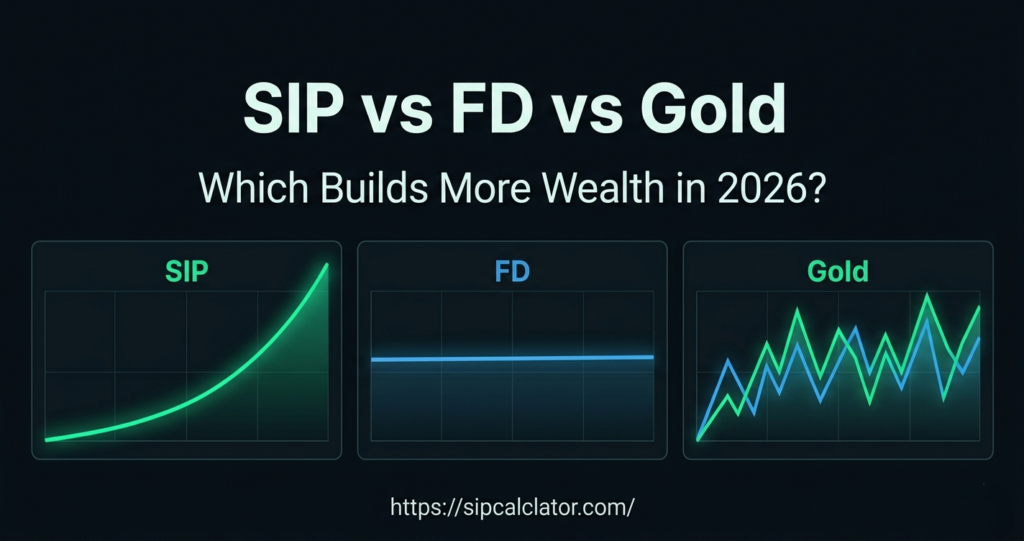
SIP vs FD vs Gold comparison showing investment growth, returns, and risk levels for long term wealth creation in India

SIP vs FD vs Gold — Where Should You Invest in 2026?

Choosing between SIP, FD, and Gold is one of the most common investment decisions in India. SIP offers market-linked growth,..........

Disclaimer: This SIP Calculator is provided for informational and educational purposes only. The results are estimates based on the inputs provided and assume a constant rate of return. Actual mutual fund returns may vary significantly. This tool does not constitute financial advice. Please consult a qualified financial advisor before making investment decisions.